

The structure and formation of words
Kurs ishlari | Ingliz tili



12 500 so'm
- Betlar soni:39 ta
- Fayl hajmi :67.67 KB
- Fayl turi:.docx
Mahsulot tavsifi
The structure and formation of words
The structure and formation of words
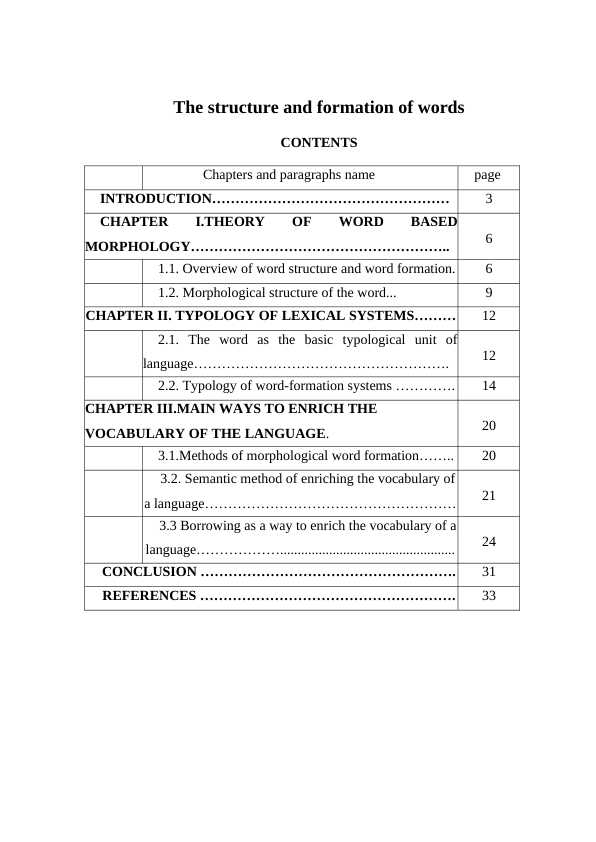
CONTENTS
| Chapters and paragraphs name | page | |
| INTRODUCTION…………………………………………… | 3 | |
| CHAPTER I.THEORY OF WORD BASED MORPHOLOGY……………………………………………….. |
6 | |
| 1.1. Overview of word structure and word formation. | 6 | |
| 1.2. Morphological structure of the word... | 9 | |
| CHAPTER II. TYPOLOGY OF LEXICAL SYSTEMS……… | 12 | |
| 2.1. The word as the basic typological unit of language………………………………………………. |
12 | |
| 2.2. Typology of word-formation systems …………. | 14 | |
| CHAPTER III.MAIN WAYS TO ENRICH THE VOCABULARY OF THE LANGUAGE. |
20 | |
| 3.1.Methods of morphological word formation…….. | 20 | |
| 3.2. Semantic method of enriching the vocabulary of a language……………………………………………… |
21 | |
| 3.3 Borrowing as a way to enrich the vocabulary of a language……………….................................................. |
24 | |
| CONCLUSION ………………………………………………. | 31 | |
| REFERENCES ………………………………………………. | 33 | |
INTRODUCTION
Humans use language for communication with each other, and language is a system of communication. It is useful to compare it with other systems of communication. For instance, humans communicate not just through language but through such means as gesture, art, dress and music . It means that people communicate not only use language as communication but also through other system. English is one of language that most widely used in the world. English is one of important subject in schools.[1]
One of the important decisions to strengthen the teaching of foreign languages and improve its quality was made by the President of the Republic of Uzbekistan, Sh. Mirziyoyev, on May 6, 2021. as noted at the video selector meeting, "Starting next year, new foreign language teachers will be required to have a national and international certificate. This, in turn, will affect English is a great attention. Being able to master the four basics language skills, the learner should have the capability of using body language in English teaching classes. One of the most important aspects of a thesis, dissertation or research paper is the correct formulation of the aims and objectives. This is because your aims and objectives will establish the scope, depth and direction that your research will ultimately take. An effective set of aims and objectives will give your research focus and your reader clarity, with your aims indicating what is to be achieved, and your objectives indicating how it will be achieved. Where a research aim specifies what your study will answer, research objectives specify how your study will answer it. In doing so, it acts as a focal point for your research and provides your readers with clarity as to what your study is all about. Because of this, research aims are almost always located within its own subsection under the introduction section of a research document.The existence of words is usually taken for granted by the speakers of a language. To speak and understand a language means – among many other things – knowing the words of that language. The average speaker knows thousands of words, and new words enter our minds and our language on a daily basis. This module is about words. More specifically, it deals with the internal structure of complex words, i.e. words that are composed of more than one meaningful element. Take, for example, the very word meaningful, which could be argued to consist of two elements, meaning and -ful, or even three, mean, -ing, and – ful. We will address the question of how such words are related to other words and how the language allows speakers to create new words. For example, meaningful seems to be clearly related to colorful, but perhaps less so to awful or plentiful. And, given that meaningful may be paraphrased as ‘having (a definite) meaning’, and colorful as ‘having (bright or many different) colors’, we could ask whether it is also possible to create the word coffeeful, meaning ‘having coffee’. Under the assumption that language is a rule-governed system, it should be possible to find meaningful answers to such questions.
It has been estimated that average speakers of a language know from 45,000 to 60,000 words. This means that we as speakers must have stored these words somewhere in our heads, our so-called mental lexicon. But what exactly is it that we have stored? What do we mean when we speak of ‘words’? In non-technical every-day talk, we speak about ‘words’ without ever thinking that this could be a problematic notion. In this section we will see that, perhaps contra our first intuitive feeling, the ‘word’ as a linguistic unit deserves some attention, because it is not as straightforward as one might expect. If you had to define what a word is, you might first think of the word as a unit in the writing system, the so-called orthographic word. You could say, for example, that a word is an uninterrupted string of letters which is preceded by a blank space and followed either by a blank space or a punctuation mark. In traditional grammar, words are the basic units of analysis. Grammarians classify words according to their parts of speech and identify and list the forms that words can show up in. Words are the main units used for entries in dictionaries. In fact Words are potentially complex units, composed of even more basic units, called morphemes. A morpheme is the smallest part of a word that has grammatical function or meaning.Language users do this in three major ways. One way is to simply import a useful word from another language, just like people import useful products from other countries. This is how an Italian word like pizza or a Japanese word like karaoke became English words. Words that are circulated in this way among languages are called borrowings. Secondly, language users can change the meaning of words already in the language, to make them mean different things. The English word sad, for example, is currently used to mean something similar to ‘pathetic‘, besides keeping its meaning of ‘unhappy’. In this new use, a sad joke is not a joke that makes you cry, but a joke that doesn’t make you laugh. A third way of creating new words in a language involves manipulating not just their meaning but also their grammar, by disassembling the morphemes from the words in which they appear, and reassembling them into new words. This is what word formation is about. Knowing that a morpheme –er means ‘someone who Vs’, as we saw in the previous chapter, we can safely create a brand-new noun emailer to mean ‘someone who emails’, and use it straight away to say that My friend Janice is a compulsive emailer.
The purpose of the course work: to develop scientific and methodological recommendations about the structure and formation of words.
The subject of the course work: Skills of introduction to the structure and formation of words
Practical importance of course work. It serves to effectively use the ideas, approaches and results of the course work, which ensure their effectiveness, in the preparation of lectures on pedagogical subjects, in the creation of manuals, as well as in the creation of methodical recommendations, in popularizing work experiences.
The structural structure and volume of the course work: the work consists of an introduction, 2 chapters, 4 sections, general conclusions and recommendations, a list of used literature
CHAPTER I.THEORY OF WORD BASED MORPHOLOGY.
1.1.Overview of word structure and word formation.
[1] Decree оf the President оf the Republic оf Uzbekistаn dаted Februаry 7, 2017 Nо. DP-4947 "Оn the Аctiоn Strаtegy fоr further develоpment оf the Republic оf Uzbekistаn".


Soffchi PhD
Yuklanmoqda...
0 ta izoh