

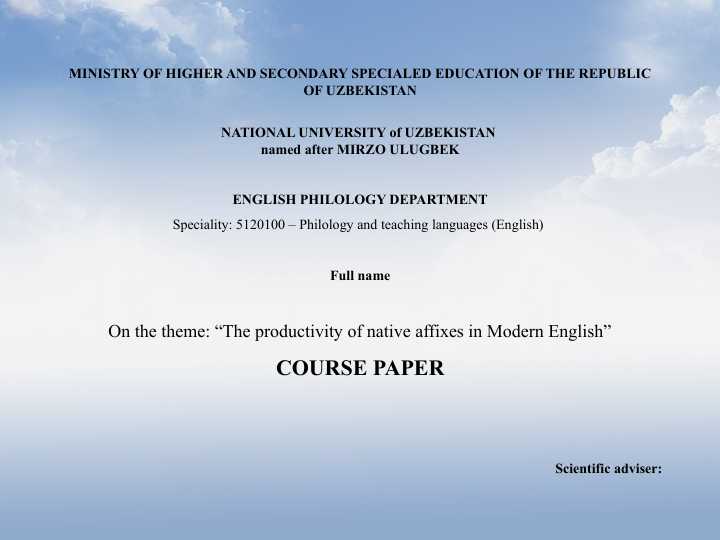
The productivity of native affixes in Modern English
Amaliy ishlar | Ingliz tili


146
Mualliflik huquqi buzilgan holatdashikoyat qiling!
9 000 so'm
- Betlar soni:13 ta
- Fayl hajmi :1.91 MB
- Fayl turi:.pptx
Mahsulot tavsifi
Overall Plan: The Productivity of Native Affixes in Modern English
I. Introduction
- A. Presentation Title and Author Information
- B. Aim of the Research (Implicit from tasks): 1. To define productive and non-productive ways of word-formation. 2. To classify types of English affixes. 3. To show the fertility of affixation in Modern English.
- C. Course Paper Context
- D. Scientific Adviser Information
II. Chapter I: Ways of Enriching Vocabulary
- A. Factors Influencing Vocabulary Enrichment (Extra-linguistic, Linguistic)
- B. Main Ways of Vocabulary Enrichment (Word formation, Borrowings, Semantic derivation)
- C. 1.1 Word-building in Modern English 1. Morphemes: Root, Affix 2. Affix Classification: a. According to place: Prefix, Infix, Suffix b. According to meaning: Derivational, Functional
- D. 1.2. Productive and Non-productive Ways of Word-formation
III. Chapter II: Affixation in Modern English
- A. 2.1. Types of English Affixes 1. Infix (Definition and example) 2. Prefix (Definition and example) 3. Suffix (Definition and example)
- B. Root, Stem, Base (Definitions and examples)
- C. 2.2 Fertility of Affixation in Modern English
IV. Conclusion
- A. Summary of Productivity (ability to form new words)
- B. Most productive ways of word-formation (affixation, conversion, word-composition, abbreviation)
- C. Changes in productivity over time (e.g., sound interchange vs. affixation)
- D. Affirmation of affixation's continued productivity in Modern English
V. The List of Used Literature


Abdumalik 169017
61 ta
90 ta
Yuklanmoqda...
0 ta izoh