

THE PHONOLOGICAL STATUS OF DIPHTHONGS
Kurs ishlari | Ingliz tili



12 500 so'm
- Betlar soni:17 ta
- Fayl hajmi :46.52 KB
- Fayl turi:.docx
Mahsulot tavsifi
THE PHONOLOGICAL STATUS OF DIPHTHONGS
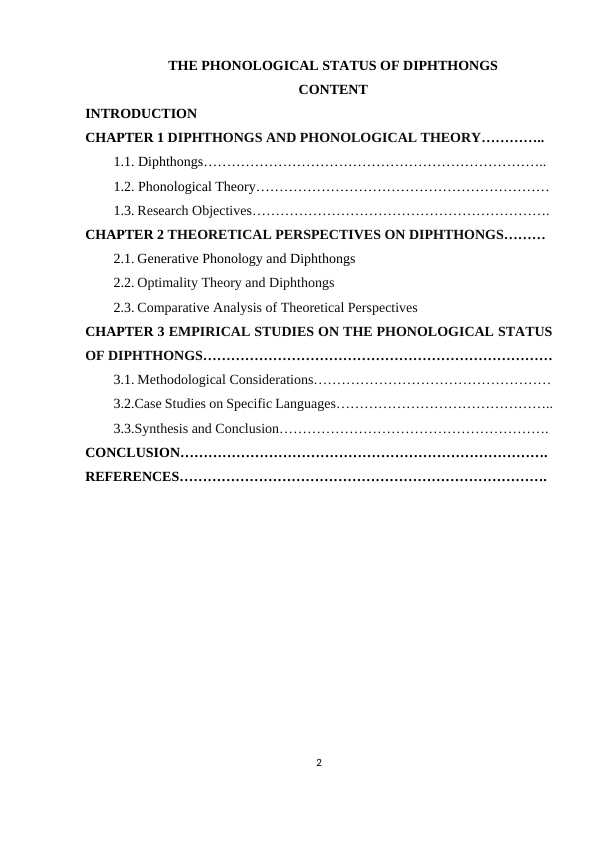
CONTENT
INTRODUCTION
CHAPTER 1 DIPHTHONGS AND PHONOLOGICAL THEORY…………..
1.1. Diphthongs………………………………………………………………..
1.2. Phonological Theory………………………………………………………
1.3. Research Objectives……………………………………………………….
CHAPTER 2 THEORETICAL PERSPECTIVES ON DIPHTHONGS………
2.1. Generative Phonology and Diphthongs
2.2. Optimality Theory and Diphthongs
2.3. Comparative Analysis of Theoretical Perspectives
CHAPTER 3 EMPIRICAL STUDIES ON THE PHONOLOGICAL STATUS OF DIPHTHONGS…………………………………………………………………
3.1. Methodological Considerations……………………………………………
3.2.Case Studies on Specific Languages………………………………………..
3.3.Synthesis and Conclusion………………………………………………….
CONCLUSION…………………………………………………………………….
REFERENCES…………………………………………………………………….
INTRODUCTION
My dear children, be satisfied with one thing: we will definitely create all the conditions and opportunities for the realization of your production and talent.I consider each of you, dear ones, my son, my daughter, my grandchild.
Mirziyoyev Shavkat Miromonovich
There are two basic approaches to the phonological status of English diphthongs, which are known as the «unit theory» and «analytic treatment». The unit theory suggested by the Prague phonologists (N.S.Trubetzkoy, B.Tmka, J.Vachek) is based on the certain rules for the determination of the mono- and biphonematic realizations of the combinations of two phonemes. The criteria used in the unit theory are as follows: 1) diphthongs may be produced by unit articulatory movements and their length is almost equal to that of simple vowels (monophthongs); 2) diphthongs are monosyllabic combinations, i.e. their two elements - a nucleous and a glide - do not belong to different syllables of a word; 3) according to the functional criterion the distinctive function of a diphthong may be established by two rules: a) the combination is biphonemic if its components may function as distinctively different elements, i.e. if it can be substituted. If the combination may fulfill its distinctive function, it is monophonematic; b) if the combination has its correlation pair among the simple phonemes, then it is monophonematic. They are opposed to the remaining diphthongs, whose second elements move towards the central neutral vowel /a/ [3, P.90]. Usually these two groups of diphthongs are called closing and centring diphthongs. J. Vachek classifies them as «movement diphthongs» which are constituted by a direct articulatory movement and cannot be divided into two vowels /ei, ai, au, au/ and therefore, they are regarded as single phonemes and «positional diphthongs» which preserve the individual articulatory nature of these two elements Aa, ea, ua, oa/.
N.S. Trubetzkoy's first functional criterion, which may function as single phonemes, it is a biphonematic combination, is entirely useless. By using this principle the diphthongs /ei/, and /ou/ become biphonematic, though Trubetzkoy regarded them as single phonemes, i.e. he admitted their monophonematic value. In this case he takes into consideration the stability of diphthongs in morphological changes. This approach is formal and cannot explain the phonological status of diphthongs
The analytic treatment suggested by some American and Copenhagen linguists regards diphthongs to be biphonematic combinations. The criterion used by American linguists is based on the method of complimentary distribution. As complex segments (diphthongs) consist of two components.
The purpose of this course work: The purpose of studying the phonological status of diphthongs is to understand how these complex vowel sequences are organized and patterned in language. By investigating the phonological properties of diphthongs, researchers aim to uncover the underlying principles and rules that govern their occurrence, distribution, and behavior within a given language or across languages.
Objectives of the course work to study:
-to learn the phonological status of diphthongs;
The object of study The object of studying the phonological status of diphthongs is to gain a comprehensive understanding of how diphthongs function within the phonological system of a language. By examining their phonetic properties, distribution, and behavior, researchers aim to achieve several objectives.


Soffchi PhD
Yuklanmoqda...
0 ta izoh