

THE PHONOLOGICAL STATUS OF DIPHTHONGS
Kurs ishlari | Ingliz tili



12 500 so'm
- Betlar soni:31 ta
- Fayl hajmi :61.54 KB
- Fayl turi:.docx
Mahsulot tavsifi
THE PHONOLOGICAL STATUS OF DIPHTHONGS
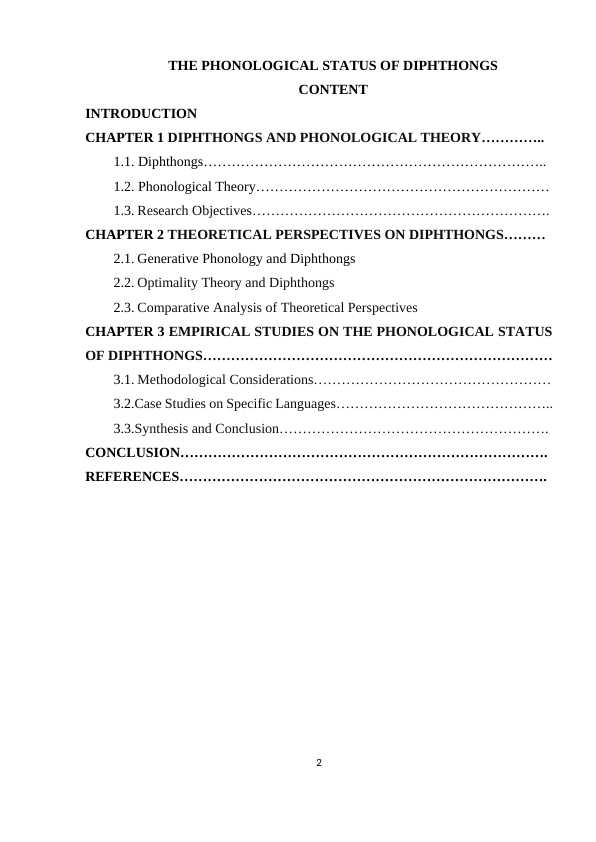
CONTENT
INTRODUCTION
CHAPTER 1 DIPHTHONGS AND PHONOLOGICAL THEORY…………..
1.1. Diphthongs………………………………………………………………..
1.2. Phonological Theory………………………………………………………
1.3. Research Objectives……………………………………………………….
CHAPTER 2 THEORETICAL PERSPECTIVES ON DIPHTHONGS………
2.1. Generative Phonology and Diphthongs
2.2. Optimality Theory and Diphthongs
2.3. Comparative Analysis of Theoretical Perspectives
CHAPTER 3 EMPIRICAL STUDIES ON THE PHONOLOGICAL STATUS OF DIPHTHONGS…………………………………………………………………
3.1. Methodological Considerations……………………………………………
3.2.Case Studies on Specific Languages………………………………………..
3.3.Synthesis and Conclusion………………………………………………….
CONCLUSION…………………………………………………………………….
REFERENCES…………………………………………………………………….
INTRODUCTION
There are two basic approaches to the phonological status of English diphthongs, which are known as the «unit theory» and «analytic treatment». The unit theory suggested by the Prague phonologists (N.S.Trubetzkoy, B.Tmka, J.Vachek) is based on the certain rules for the determination of the mono- and biphonematic realizations of the combinations of two phonemes. The criteria used in the unit theory are as follows: 1) diphthongs may be produced by unit articulatory movements and their length is almost equal to that of simple vowels (monophthongs); 2) diphthongs are monosyllabic combinations, i.e. their two elements - a nucleous and a glide - do not belong to different syllables of a word; 3) according to the functional criterion the distinctive function of a diphthong may be established by two rules: a) the combination is biphonemic if its components may function as distinctively different elements, i.e. if it can be substituted. If the combination may fulfill its distinctive function, it is monophonematic; b) if the combination has its correlation pair among the simple phonemes, then it is monophonematic.
According to the above criteria long vowels and diphthongs can be defined as single vowel phonemes, since both categories with the exception of /a:/ and /3:/ are free vowels with a variable degree of opening. In this case /i:/ and /u:/ are interpreted as /ii/ and /uu/ (but not as /ij/ and /uw/ in which the second elements appear as semi-vowels or consonants). According to the articulatory direction of the second elements, the diphthongs /ei, ai, au, au/ are parallel to those of the high, long vowels. They are opposed to the remaining diphthongs, whose second elements move towards the central neutral vowel /a/ [3, P.90]. Usually these two groups of diphthongs are called closing and centring diphthongs. J. Vachek classifies them as «movement diphthongs» which are constituted by a direct articulatory movement and cannot be divided into two vowels /ei, ai, au, au/ and therefore, they are regarded as single phonemes and «positional diphthongs» which preserve the individual articulatory nature of these two elements Aa, ea, ua, oa/.
N.S. Trubetzkoy's first functional criterion, which may function as single phonemes, it is a biphonematic combination, is entirely useless. By using this principle the diphthongs /ei/, and /ou/ become biphonematic, though Trubetzkoy regarded them as single phonemes, i.e. he admitted their monophonematic value. In this case he takes into consideration the stability of diphthongs in morphological changes. This approach is formal and cannot explain the phonological status of diphthongs
The morphological criterion which works in favour of a morphemic boundary between the two elements of a diphthong leads to its interpretation as a biphonematic combination. For example, loyal /loyal/, lower /lo: - ua/, sawing /saui^/, poet /pauit/ etc. In such words they occur at morphemic junctures in native words, or in two contiguous syllables of the same morpheme in distinctively foreign words. In words like seer /si:s/, fewer /fju:s/. B. Tmka notices the combinations of two phonemes in which the first element preserves the tendency of length.


Soffchi PhD
Yuklanmoqda...
0 ta izoh