

The Harlem Renaissance Exploring African American Artistic Expression
Kurs ishlari | Ingliz tili



12 500 so'm
- Mahsulotni sotilgan soni:1 ta
- Betlar soni:41 ta
- Fayl hajmi :60.34 KB
- Fayl turi:.docx
Mahsulot tavsifi
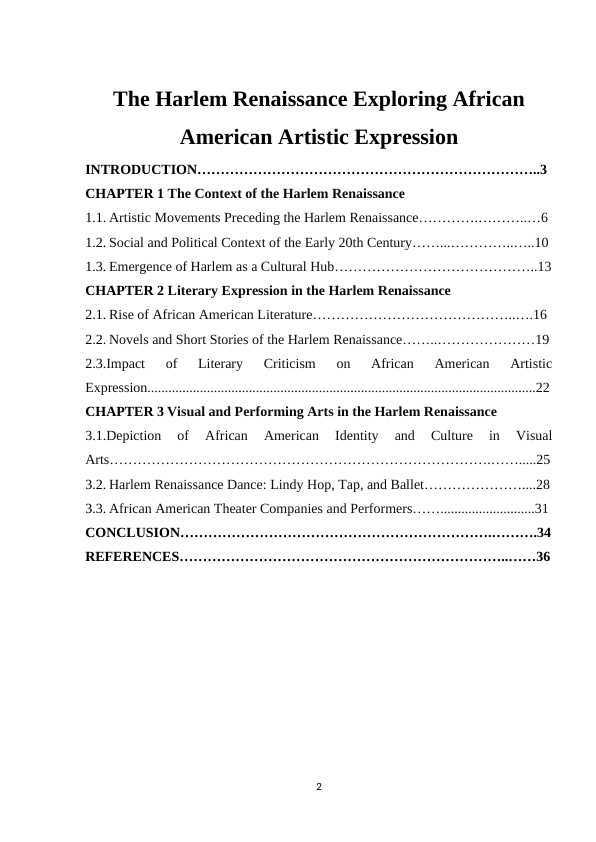
The Harlem Renaissance Exploring African American Artistic Expression
INTRODUCTION………………………………………………………………..3
CHAPTER 1 The Context of the Harlem Renaissance
1.1. Artistic Movements Preceding the Harlem Renaissance………….………..…6
1.2. Social and Political Context of the Early 20th Century……...…………..…..10
1.3. Emergence of Harlem as a Cultural Hub……………………………………..13
CHAPTER 2 Literary Expression in the Harlem Renaissance
2.1. Rise of African American Literature……………………………………..….16
2.2. Novels and Short Stories of the Harlem Renaissance……..…………………19
2.3.Impact of Literary Criticism on African American Artistic Expression...............................................................................................................22
CHAPTER 3 Visual and Performing Arts in the Harlem Renaissance
3.1.Depiction of African American Identity and Culture in Visual Arts……………………………………………………………………….…….....25
3.2. Harlem Renaissance Dance: Lindy Hop, Tap, and Ballet…………………....28
3.3. African American Theater Companies and Performers……...........................31
CONCLUSION………………………………………………………….……….34
REFERENCES……………………………………………………………..……36
INTRODUCTION
The relevance of course work centered on the Harlem Renaissance lies in its profound impact on American culture, society, and the arts. Emerging in the early 20th century in the vibrant neighborhood of Harlem, New York City, the Harlem Renaissance marked a pivotal moment in history, where African American artists, writers, musicians, and intellectuals flourished and reshaped the cultural landscape of the nation. By delving into the artistic expressions and cultural innovations of this period, coursework on the Harlem Renaissance provides a lens through which to explore issues of identity, creativity, and social change. English-centric world. The following basic concepts are applied in this Law state accreditation — process of state recognition of the compliance of the activities of state educational institutions and organizations, non-state educational organizations (hereinafter - educational organizations) with state educational standards, state educational requirements and curricula, as well as granting the right to issue their graduates with educational documen[1]
The purpose of scientific research The topic Scientific research contributes to educational outreach and engagement initiatives aimed at promoting awareness and understanding of the Harlem Renaissance. By disseminating research findings through exhibitions, publications, and public programs, researchers can engage audiences of all ages in meaningful dialogue about the significance of African American artistic expression and its relevance to contemporary issues of race, identity, and cultural heritage. In summary, the purpose of scientific research within the context of exploring African American artistic expression during the Harlem Renaissance is to document, analyze, and interpret the cultural significance of this transformative period in American history. By uncovering the stories, voices, and achievements of African American artists, researchers contribute to a deeper understanding of the Harlem Renaissance as a pivotal moment in the ongoing struggle for cultural recognition, social justice, and human dignity.
The decision of the President of the Republic of Uzbekistan "On provision of information and communication technologies and personal education with highly qualified personnel of Uzbekistan, additional support for the development of information technologies, development of scientific technologies and their integration with information and communication technologies[2]"
The tasks of the theme The coursework Harlem Renaissance encompass a range of responsibilities for scholars and educators. Researchers are tasked with examining primary sources, archival materials, and scholarly literature to uncover the historical, social, and cultural contexts of the Harlem Renaissance. Educators are tasked with designing and implementing curriculum units, lessons, and educational materials that explore the artistic expressions and cultural significance of the Harlem Renaissance in diverse educational settings. Additionally, both researchers and educators may collaborate with cultural institutions, community organizations, and artists to promote public awareness and engagement with the Harlem Renaissance.
The theory of course paper on the Harlem Renaissance draw upon interdisciplinary perspectives, including literary studies, art history, cultural studies, and African American studies. At its core, this coursework explores the intersections of race, identity, and artistic expression during a pivotal moment in American history. The Harlem Renaissance is viewed as a site of cultural production and contestation, where African American artists and intellectuals negotiated issues of representation, identity, and social justice through their creative works.
The methodological framework Methodologically, the exploration of the Harlem Renaissance requires a multidisciplinary and intersectional approach. Researchers and educators may employ a variety of research methods, including archival research, textual analysis, visual analysis, and oral history interviews, to uncover the diverse voices and experiences of African American artists and intellectuals during this period. Furthermore, educators may utilize innovative pedagogical approaches, such as project-based learning, experiential learning, and arts integration, to engage students in critical inquiry and creative expression inspired by the Harlem Renaissance. In summary, this introductory segment provides an overview of the Harlem Renaissance as a rich and dynamic cultural movement, highlighting its relevance, the purpose of scientific research, the tasks inherent within this theme, the theoretical underpinnings, and the methodological framework for its exploration. As scholars and educators delve into the artistic expressions and cultural innovations of the Harlem Renaissance, they contribute to a deeper understanding of African American history, culture, and artistic achievement, while also fostering critical thinking, creativity, and cultural appreciation among students and audiences.
[1] Law of the Republic of Uzbekistan on Education.23.09.2020y.№ LRU-637
[2] President Of The Republic Of Uzbekistan Sh. MIRZIYOYEV Tashkent,August 22, 2022, PQ-357


Soffchi PhD
Yuklanmoqda...
0 ta izoh