

Methods and criteria for evaluating language aspects
Kurs ishlari | Ingliz tili



12 500 so'm
- Betlar soni:38 ta
- Fayl hajmi :44.29 KB
- Fayl turi:.docx
Mahsulot tavsifi
Methods and criteria for evaluating language aspects
Methods and criteria for evaluating language aspects
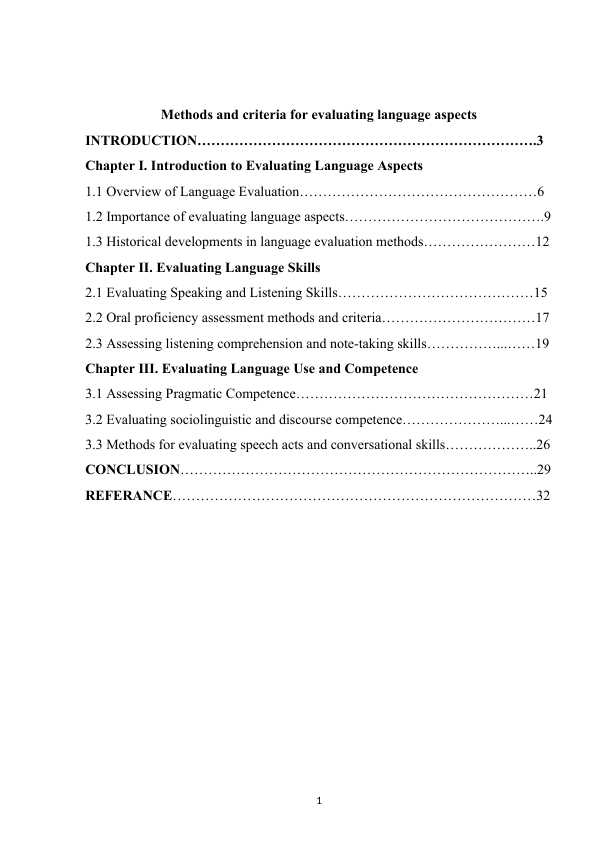
INTRODUCTION……………………………………………………………….3
Chapter I. Introduction to Evaluating Language Aspects
1.1 Overview of Language Evaluation……………………………………………6
1.2 Importance of evaluating language aspects…………………………………….9
1.3 Historical developments in language evaluation methods……………………12
Chapter II. Evaluating Language Skills
2.1 Evaluating Speaking and Listening Skills……………………………………15
2.2 Oral proficiency assessment methods and criteria……………………………17
2.3 Assessing listening comprehension and note-taking skills……………...……19
Chapter III. Evaluating Language Use and Competence
3.1 Assessing Pragmatic Competence……………………………………………21
3.2 Evaluating sociolinguistic and discourse competence…………………...……24
3.3 Methods for evaluating speech acts and conversational skills………………..26
CONCLUSION…………………………………………………………………..29
REFERANCE……………………………………………………………………32
INTRODUCTION
The relevance of course work The study of methods and criteria for evaluating language aspects holds profound relevance in contemporary linguistic inquiry. Language serves as the bedrock of human communication, permeating every facet of our personal, professional, and societal interactions. Understanding how to effectively evaluate language aspects enables scholars and practitioners to decode the intricate mechanisms underlying linguistic expression. In an era marked by globalization and digital connectivity, the need for accurate and comprehensive language assessment is more pronounced than ever. Evaluating language aspects not only facilitates effective communication across diverse linguistic communities but also underpins critical processes such as education, policymaking, and cross-cultural understanding. Moreover, with the burgeoning interest in artificial intelligence and natural language processing, the development of robust evaluation methods is crucial for enhancing the performance of language technologies. By scrutinizing language aspects through rigorous methodologies and criteria, researchers can refine computational models and algorithms, thereby advancing the capabilities of automated language processing systems. The following basic concepts are applied in this Law state accreditation — process of state recognition of the compliance of the activities of state educational institutions and organizations, non-state educational organizations (hereinafter - educational organizations) with state educational standards, state educational requirements and curricula, as well as granting the right to issue their graduates with educational documen[1]
[1] Law of the Republic of Uzbekistan on Education.23.09.2020y.№ LRU-637


Soffchi PhD
Yuklanmoqda...
0 ta izoh