

Factors and Feature of multiple intelligences
Kurs ishlari | Ingliz tili



12 500 so'm
- Betlar soni:36 ta
- Fayl hajmi :60.09 KB
- Fayl turi:.docx
Mahsulot tavsifi
Factors and Feature of multiple intelligences
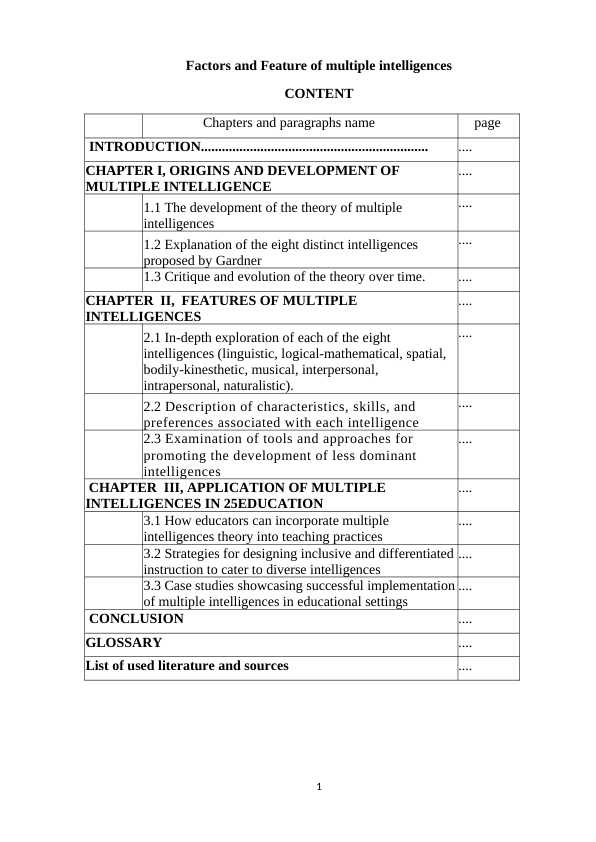
CONTENT
| Chapters and paragraphs name | page | |
| INTRODUCTION................................................................. | .... | |
| CHAPTER I, ORIGINS AND DEVELOPMENT OF MULTIPLE INTELLIGENCE | .... | |
| 1.1 The development of the theory of multiple intelligences | .... | |
| 1.2 Explanation of the eight distinct intelligences proposed by Gardner | .... | |
| 1.3 Critique and evolution of the theory over time. | .... | |
| CHAPTER II, FEATURES OF MULTIPLE INTELLIGENCES | .... | |
| 2.1 In-depth exploration of each of the eight intelligences (linguistic, logical-mathematical, spatial, bodily-kinesthetic, musical, interpersonal, intrapersonal, naturalistic). | .... | |
| 2.2 Description of characteristics, skills, and preferences associated with each intelligence | .... | |
| 2.3 Examination of tools and approaches for promoting the development of less dominant intelligences | .... | |
| CHAPTER III, APPLICATION OF MULTIPLE INTELLIGENCES IN 25EDUCATION | .... | |
| 3.1 How educators can incorporate multiple intelligences theory into teaching practices | .... | |
| 3.2 Strategies for designing inclusive and differentiated instruction to cater to diverse intelligences | .... | |
| 3.3 Case studies showcasing successful implementation of multiple intelligences in educational settings | .... | |
| CONCLUSION | .... | |
| GLOSSARY | .... | |
| List of used literature and sources | .... | |
INTRODUCTION
The relevance of course work Understanding the factors and features of multiple intelligences holds significant relevance in contemporary education and psychology. As traditional measures like IQ focus primarily on linguistic and logical-mathematical abilities, the concept of multiple intelligences broadens our understanding of human cognition. By recognizing diverse intellectual strengths such as interpersonal, intrapersonal, musical, spatial, bodily-kinesthetic, naturalistic, and existential intelligences, educators can tailor teaching methods to cater to individual learning styles. This approach fosters inclusive education, allowing every student to excel in their unique talents and abilities. Moreover, comprehending the factors influencing these intelligences, such as genetics, environment, and upbringing, provides insights into optimizing learning environments and nurturing talent effectively. Embracing multiple intelligences not only enhances academic achievement but also promotes holistic development, self-awareness, and appreciation of diverse forms of human intelligence in various facets of life.
The agency and its representatives are 34 state units of the republican scientific-practical center for the development of innovative methods of teaching foreign languages under the State University of World Languages of Uzbekistan, 39 states of the system of the Ministry of Public Education and the Ministry of Higher and Secondary Special Education. it is accepted for information that it was organized at the expense of the unit[1].
The purpose of scientific research The scientific research on factors and features of multiple intelligences serves to deepen our understanding of human cognition and learning processes. By investigating how various factors such as genetics, environment, and experience influence the development and expression of different intelligences, researchers aim to uncover the complexities of intelligence beyond traditional measures. This research provides insights into optimizing educational practices by tailoring instruction to individual strengths and preferences. Additionally, understanding the factors contributing to multiple intelligences can inform interventions for individuals with learning differences or developmental disorders, promoting inclusive education. Moreover, scientific inquiry in this field contributes to advancing psychological theories and methodologies, enhancing our overall comprehension of human diversity and potential. Ultimately, the purpose of this scientific research is to foster more effective educational practices, promote inclusive learning environments, and further our understanding of human intelligence in all its diverse manifestations.
The tasks of the theme The scientific research on factors and features of multiple intelligences serves a multifaceted purpose in contemporary education and psychology. Firstly, it aims to broaden our understanding of intelligence beyond traditional measures like IQ, recognizing the diverse ways in which individuals excel cognitively. By investigating the interplay of genetic predispositions, environmental influences, and personal experiences in shaping different intelligences, researchers seek to unravel the complexities of human cognition. This deeper understanding informs educators on how to tailor instructional strategies to accommodate diverse learning styles and strengths, fostering more effective teaching practices and enhancing student engagement and academic performance. Moreover, scientific inquiry into multiple intelligences contributes to the development of more inclusive educational environments. By acknowledging and valuing various forms of intelligence, researchers strive to create learning spaces that celebrate individual differences and promote equity in education. Furthermore, this research advances psychological theories and methodologies, driving innovation in assessment tools and intervention strategies for individuals with learning differences or developmental challenges. Ultimately, the purpose of scientific research on multiple intelligences is to promote holistic development, optimize learning outcomes, and nurture the diverse talents and potential of every individual within society.
The increasing position of the English language in the world and the reasons for teaching English by Lingua Franca in Uzbekistan, as well as the impact of the President's decisions on strengthening the teaching of this language at all levels of education after gaining independence. The use of new methods and experience of a country with a high educational rating (Finland) in teaching a foreign language is studied[2].
The theory of course paper The Factors and Features of multiple intelligences delves into the multifaceted nature of human cognition and its implications for education and psychology. Developed by Howard Gardner, the theory of multiple intelligences suggests that intelligence is not solely confined to traditional measures like IQ but encompasses a wide array of abilities and talents. These intelligences include linguistic, logical-mathematical, spatial, bodily-kinesthetic, musical, interpersonal, intrapersonal, naturalistic, and even existential dimensions.
The theory posits that individuals possess varying degrees of proficiency across these intelligences, with each person having a unique profile of strengths and weaknesses. Moreover, multiple factors influence the development and expression of these intelligences, such as genetics, environment, culture, and personal experiences. Understanding these factors is crucial for educators as it enables them to tailor instruction to accommodate diverse learning styles and preferences, thereby optimizing learning outcomes for all students. Furthermore, recognizing and valuing the diversity of intelligences fosters inclusive education practices that celebrate the unique talents and potential of each individual. By embracing the theory of multiple intelligences, educators can create enriching learning environments that nurture holistic development and empower students to excel in their areas of strength. Thus, the study of Factors and Features of multiple intelligences holds profound implications for shaping educational practices and promoting lifelong learning
[1] Paragraph 2 of Decision No. PQ-5117:
[2] https://cyberleninka.ru/article/n/o-zbekiston-ta-lim-tizimida-ingliz-tili/viewer


Soffchi PhD
Yuklanmoqda...
0 ta izoh