

EMILY DICKENSON , MARGARET FULLER IN POETRY
Kurs ishlari | Ingliz tili



12 500 so'm
- Betlar soni:33 ta
- Fayl hajmi :73.13 KB
- Fayl turi:.docx
Mahsulot tavsifi
EMILY DICKENSON , MARGARET FULLER IN POETRY
EMILY DICKENSON , MARGARET FULLER IN POETRY
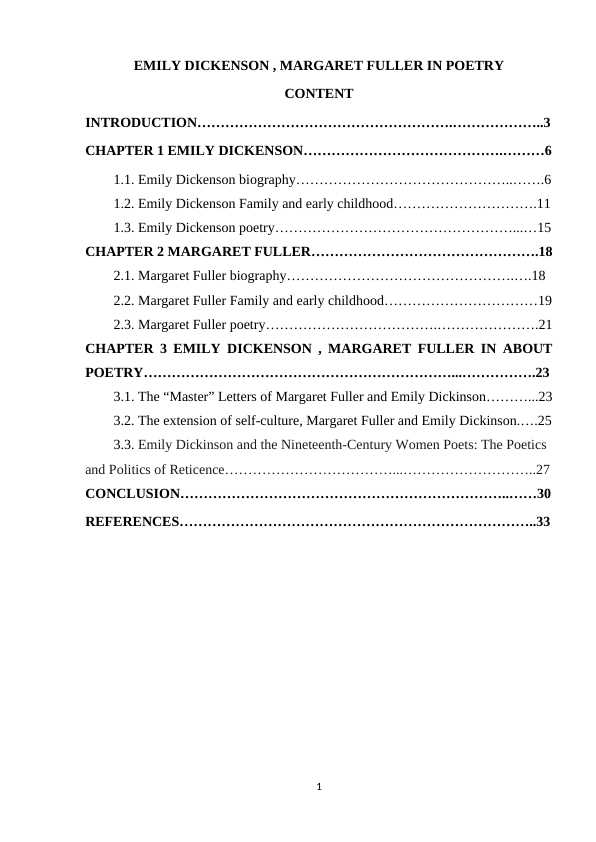
CONTENT
INTRODUCTION……………………………………………….………………..3
CHAPTER 1 EMILY DICKENSON…………………………………….………6
1.1. Emily Dickenson biography………………………………………..…….6
1.2. Emily Dickenson Family and early childhood………………………….11
1.3. Emily Dickenson poetry……………………………………………...…15
CHAPTER 2 MARGARET FULLER………………………………………….18
2.1. Margaret Fuller biography………………………………………….….18
2.2. Margaret Fuller Family and early childhood……………………………19
2.3. Margaret Fuller poetry……………………………….………………….21
CHAPTER 3 EMILY DICKENSON , MARGARET FULLER IN ABOUT POETRY…………………………………………………………...…………….23
3.1. The “Master” Letters of Margaret Fuller and Emily Dickinson………...23
3.2. The extension of self-culture, Margaret Fuller and Emily Dickinson.….25
3.3. Emily Dickinson and the Nineteenth-Century Women Poets: The Poetics and Politics of Reticence………………………………...………………………..27
CONCLUSION……………………………………………………………..……30
REFERENCES…………………………………………………………………..33
INTRODUCTION.
Emily Dickinson and Margaret Fuller are two influential figures in the realm of poetry, each contributing significantly to literature in their own distinct ways.
Emily Dickinson (1830–1886) is widely regarded as one of America's greatest poets. Despite living a reclusive life in Amherst, Massachusetts, she produced nearly 1,800 poems, many of which were discovered after her death. Dickinson's poetry is characterized by its concise yet profound style, often exploring themes of death, nature, love, and the human experience. Her unconventional use of punctuation, capitalization, and imagery creates a distinctive poetic voice that continues to captivate readers today. Dickinson's work challenged the conventions of her time and laid the groundwork for modernist poetry.
Margaret Fuller (1810–1850) was an American journalist, critic, and women's rights advocate. She played a significant role in the transcendentalist movement of the 19th century and was associated with prominent figures such as Ralph Waldo Emerson and Henry David Thoreau. Fuller's literary contributions include her groundbreaking work "Woman in the Nineteenth Century," which argued for women's equality and challenged traditional gender roles. Additionally, Fuller was an accomplished literary critic, providing insightful analysis of contemporary literature and advocating for a more inclusive and progressive literary culture.
In poetry, both Dickinson and Fuller made notable contributions, although their approaches and styles differed. Dickinson's introspective and often enigmatic verse delves into the complexities of human emotion and existence, while Fuller's writings, including poetry, focused on social justice, women's rights, and the broader issues of her time. Despite their differences, both poets left an indelible mark on American literature, inspiring generations of writers and thinkers with their words and ideas.
Certainly! Let's delve a bit deeper into the contributions of Emily Dickinson and Margaret Fuller in the realm of poetry:
Emily Dickinson:


Soffchi PhD
Yuklanmoqda...
0 ta izoh