

BORROWINGS OF MIDDLE ENGLISH PERIOD
Kurs ishlari | Ingliz tili



12 500 so'm
- Betlar soni:32 ta
- Fayl hajmi :52.87 KB
- Fayl turi:.docx
Mahsulot tavsifi
BORROWINGS OF MIDDLE ENGLISH PERIOD
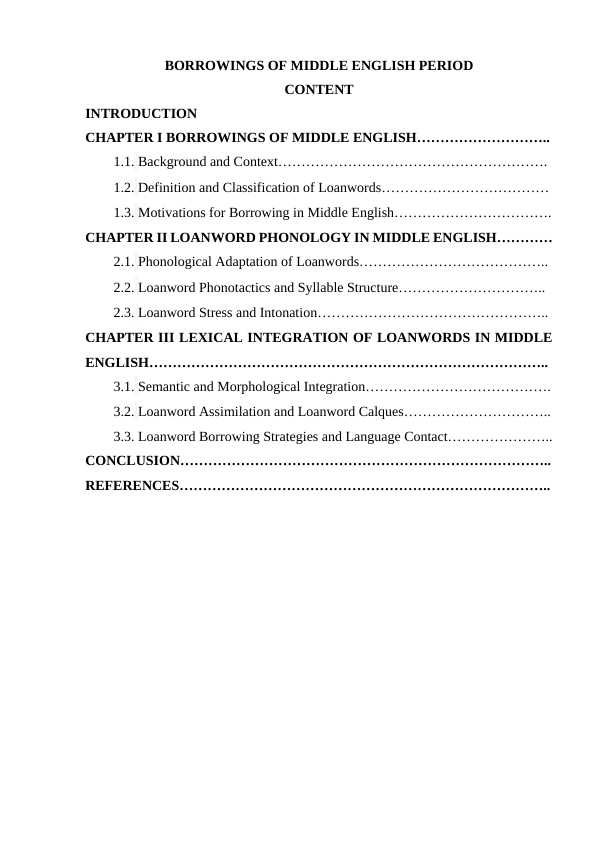
CONTENT
INTRODUCTION
CHAPTER I BORROWINGS OF MIDDLE ENGLISH………………………..
1.1. Background and Context………………………………………………….
1.2. Definition and Classification of Loanwords………………………………
1.3. Motivations for Borrowing in Middle English…………………………….
CHAPTER II LOANWORD PHONOLOGY IN MIDDLE ENGLISH…………
2.1. Phonological Adaptation of Loanwords…………………………………..
2.2. Loanword Phonotactics and Syllable Structure…………………………..
2.3. Loanword Stress and Intonation…………………………………………..
CHAPTER III LEXICAL INTEGRATION OF LOANWORDS IN MIDDLE ENGLISH…………………………………………………………………………..
3.1. Semantic and Morphological Integration………………………………….
3.2. Loanword Assimilation and Loanword Calques…………………………..
3.3. Loanword Borrowing Strategies and Language Contact…………………..
CONCLUSION……………………………………………………………………..
REFERENCES……………………………………………………………………..
INTRODUCTION
"A solid foundation for the future of teaching foreign languages the time has come to establish a new system that will be - says their own our honorable president Shavkat Mirziyoyev in his lectures. Each of Uzbekistan the growing young generation is no less than anyone else, world education It is necessary to be fully educated-scientific who can fully meet the level of standards and we have to get into it with all our heart.[1]
Shavkat Miromonovich Mirziyoyev
During the Middle English period (approximately 1100 to 1500), the English language underwent significant changes and transformations. One of the notable features of this period was the introduction of borrowings from other languages. Here are some key aspects of the borrowings during the Middle English period.The most significant influence on Middle English vocabulary came from French, specifically Old Norman, which was spoken by the ruling classes after the Norman Conquest of England in 1066. French loanwords entered English in large numbers and covered various domains such as law, government, religion, art, literature, and cuisine. Many words related to chivalry, courtly love, fashion, and administration were borrowed from French during this period. Examples include "government," "royalty," "castle," "prison," "beauty," "court," and "cuisine."Latin was the language of the Church, education, and scholarship during the Middle Ages, and it exerted a significant influence on the English language. Latin borrowings primarily occurred in the fields of religion, science, medicine, and law. Ecclesiastical terms, such as "clergy," "bishop," "pope," and "saint," were borrowed from Latin. Latin also contributed to the development of scientific and medical vocabulary, with words like "medicine," "biology," "astronomy," and "chemistry" entering the English lexicon.The Viking invasions and subsequent settlements in the British Isles left their mark on the English language. Old Norse, the language spoken by the Norsemen, had an impact on the vocabulary of Old English, and this influence continued into the Middle English period. Scandinavian loanwords include terms related to seafaring, trade, and everyday life, such as "knife," "husband," "anger," "ransack," "plunder," and "skull."Besides French, Latin, and Scandinavian, Middle English also borrowed words from other languages. For instance, Old English had already borrowed words from Old Norse, and these Norse borrowings continued during the Middle English period too. Additionally, Middle English borrowed words from Italian, Spanish, Dutch, and Arabic, particularly in later centuries.It's important to note that during the Middle English period, the borrowed words underwent phonetic and spelling changes to adapt to the English language. The influx of loanwords contributed to the expansion and enrichment of the English vocabulary, shaping the language as it evolved into Modern English.
Here are some additional details about the borrowings during the Middle English period. When foreign words were borrowed into Middle English, they often underwent phonetic and spelling changes to fit the English sound system and writing conventions. For example, French words with initial /kw/ sounds were adapted to /kw/ or /k/ in English, hence "quench" from French "quenchir." Similarly, French words with the /ʒ/ sound became /dʒ/ in English, as seen in "journey" from French "journée." These adaptations helped integrate the borrowed words into the English language.Borrowed words sometimes underwent semantic shifts or changes in meaning during the Middle English period. This could occur through the influence of the borrowing language or due to native English usage. For instance, the Old English word "spel" meant "story" or "narrative," but with the influence of the French borrowing "espeil," meaning "mirror," the English word "spel" evolved to mean "game of guessing" or "riddle."The borrowings during the Middle English period often reflected social and linguistic prestige. French loanwords, in particular, were associated with the aristocracy, the court, and high culture. These words were used in formal and literary contexts, while everyday and informal language continued to draw from native English vocabulary. This division in language usage created a distinction between "high" and "low" registers within Middle English society. The borrowings during the Middle English period also influenced English grammar. For example, French borrowings introduced new verb forms, such as the use of the suffix "-ize" (from French "-iser") to create verbs like "realize" or "organize." The borrowing of prepositions and conjunctions from French also affected English syntax and sentence structure.During the Middle English period, French became a lingua franca, a common language for communication between speakers of different native languages.
- [1] PQ-5117 of the President of the Republic of Uzbekistan dated May 19, 2022 decision.


Soffchi PhD
Yuklanmoqda...
0 ta izoh